

As domestic consumption continues to upgrade, the demand for premium, specialized imported fruits—such as Chilean cherries, New Zealand kiwifruits, Thai mangosteens, and Australian citrus—has skyrocketed. These fruits have filled seasonal gaps and enriched consumer choices thanks to their unique flavors, mature cultivation practices, and counter-season availability.
However, the inherent conflict between ultra-long cross-border supply chains and the highly perishable nature of fresh produce presents a major bottleneck. The overall loss rate for imported fruit in China sits between 15% and 25%, vastly exceeding the sub-5% benchmark seen in developed nations. Cracking the code to cross-border preservation, minimizing spoilage, and locking in that “picked-yesterday” flavor is now the ultimate catalyst for industry-wide transformation.
1. The Core Dilemma: Three Preservation Gaps in Traditional Logistics
Moving fruit from overseas orchards to domestic tables involves over ten distinct steps—including harvesting, pre-cooling, grading, ocean freight, customs clearance, warehousing, and last-mile delivery. The entire journey takes anywhere from a week to over twenty days. Traditional logistics suffer from three fatal weaknesses:
- Suboptimal Harvesting & Pre-Cooling: To survive the long journey, most fruits are picked at 70–80% ripeness, before their natural sugars and flavor profiles have fully developed. Furthermore, many overseas orchards lack standardized pre-cooling equipment; failing to dissipate “field heat” immediately spikes the fruit’s respiration rate, accelerating aging right from the start.
- Outdated Maritime Transit Technology: Most ocean freight still relies on standard refrigerated containers that only control temperature. They fail to regulate humidity, gas concentrations, or microbial growth. Resulting fluctuations lead either to mold from high humidity or shriveled peels from dehydration.
- Domestic Bottlenecks & Last-Mile Breaks: Delays during customs clearance, imprecise climate control in transit warehouses, and dense stacking create a perfect storm for rapid spoilage. Worse yet, the “last mile” of urban delivery often reverts to ambient temperatures, causing a sharp drop in fruit quality and driving up costs that are ultimately passed on to the consumer.
2. Technological Innovation: The Three Pillars of Smart Preservation
Advanced, precise, and intelligent preservation technologies are rapidly replacing legacy cold storage to redefine cross-border logistics:
Controlled Atmosphere (CA) Technology
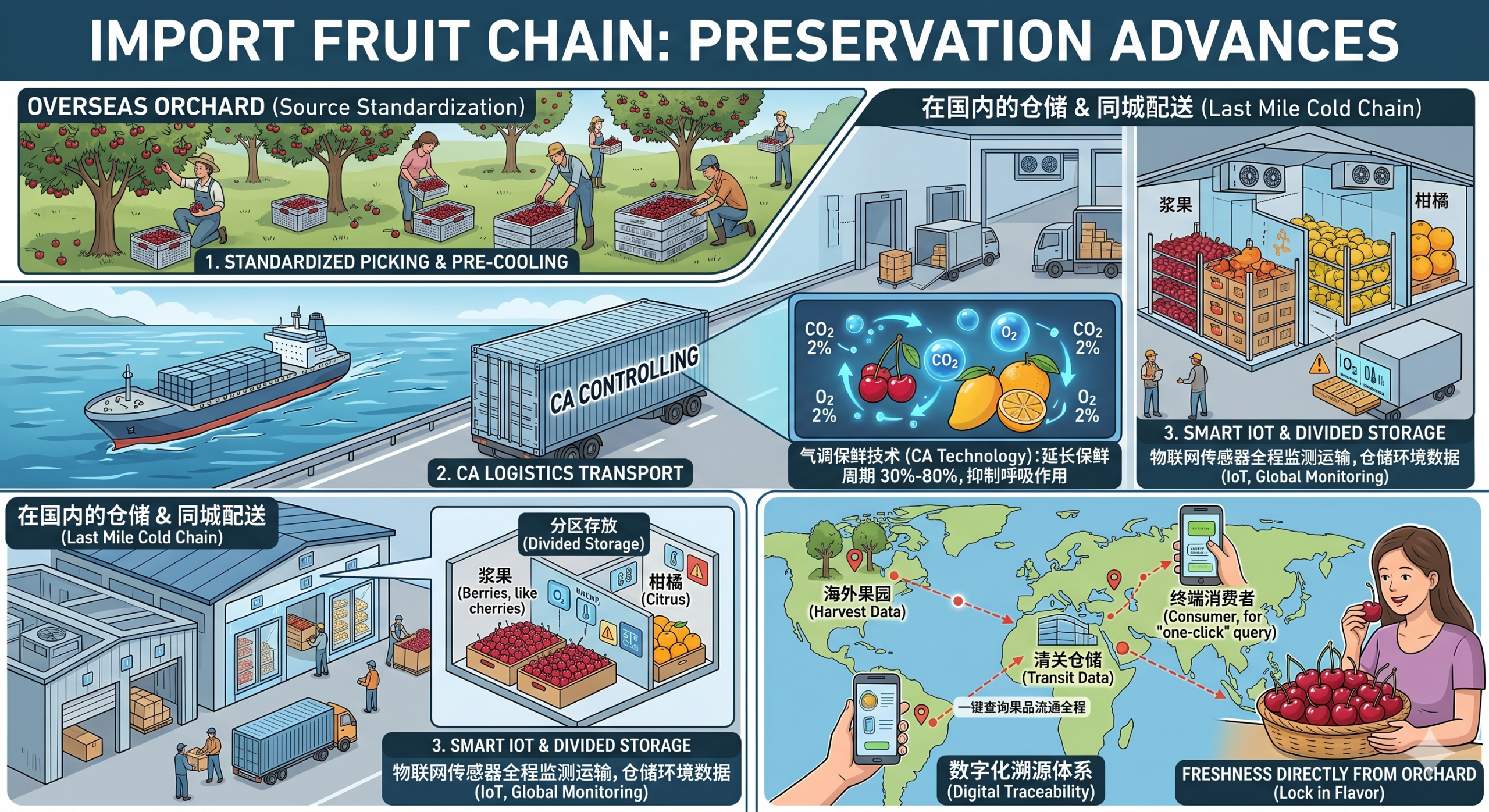
CA technology precisely regulates the concentrations of oxygen ($\text{O}_2$), carbon dioxide ($\text{CO}_2$), and nitrogen ($\text{N}_2$) within sealed environments while maintaining a constant low temperature.
The Impact: It slows down fruit respiration and delays aging, extending the shelf life by 30% to 80%. This is the gold standard for long-haul varieties like cherries, blueberries, and kiwifruits.
Novel Physical & Bio-Coatings
- Physical Antimicrobial Tech: Chemical-free methods such as low-temperature plasma and UV-C sterilization are being deployed to protect delicate berries and soft fruits.
- Edible Plant-Based Coatings: These natural coatings form a breathable protective layer on the fruit’s skin to lock in moisture and block bacteria. This brilliantly solves the dilemma for tropical fruits that are sensitive to chilling injuries at low temperatures but spoil rapidly at room temperature.
Smart IoT Sensing Systems
By embedding Internet of Things (IoT) sensors throughout the transit and warehousing phases, operators can monitor temperature, humidity, and gas levels in real time. Automatic alerts flag anomalies instantly, allowing teams to intervene before the cold chain breaks.
3. Supply Chain Optimization: Seamless End-to-End Integration
Preservation is a relay race from the orchard to the dining table. Minimizing loss requires a synchronized, end-to-end upgrade of hardware and workflows:
| Supply Chain Phase | Core Optimization Strategy | Ultimate Goal |
| Overseas Source | Empower partner orchards to establish standardized picking, flash pre-cooling, and grading systems. | Set fruit-specific harvesting metrics to lock in peak quality at the origin. |
| Cross-Border Transit | Replace legacy reefer units with smart Controlled Atmosphere (CA) containers. | Customize preservation parameters to execute a precise “one fruit, one strategy” protocol. |
| Domestic Warehousing | Streamline “green channels” for customs clearance and build specialized multi-temperature distribution centers. | Minimize customs delays and prevent cross-contamination or accelerated ripening caused by mixing fruit types. |
| Last-Mile Delivery | Upgrade urban fleets with small temperature-controlled vehicles and active thermal boxes. | Eliminate ambient-temperature exposure during final delivery, ensuring a seamless cold chain. |
4. Long-Term Mechanisms: Standardization & Digital Traceability
Beyond hardware and tech, the industry’s long-term health hinges on regulatory and digital infrastructure:
- Establishing Industry Standards: Developing standardized metrics and handling protocols for transit, storage, and waste management across different fruit categories will eliminate erratic logistics practices and phase out harmful chemical preservatives.
- Building Digital Traceability: Integrating harvest timelines, preservation treatments, real-time transit climate data, and customs logs into a unified blockchain or cloud-based tracing platform.The Value: Consumers gain transparent, “one-click” verification of freshness and safety, while supply chain enterprises are held accountable to strict, standardized operations.
Conclusion & Outlook
Solving the cross-border preservation puzzle requires a systemic approach that fuses technology, hardware infrastructure, and industry standards.
- In the Short Term: The industry must focus on rolling out new technologies and upgrading cold-chain hardware to immediately slash current fruit loss rates.
- In the Long Term: Success lies in end-to-end supply chain integration, rigorous standardization, and digital traceability to build a resilient preservation ecosystem.
As these cold-chain innovations mature, imported fruits will truly achieve a “from orchard to doorstep” seamless pipeline—delivering authentic, uncompromised flavors to consumers while unlocking a high-efficiency, premium era for cross-border fresh produce logistics.
